Irvine vs. Seoul: Which Is Really More Expensive?

Updated: Sep 5
Irvine and Seoul are both known for their high housing costs. But the answer to “Which is more expensive?” isn’t as simple as it might seem.
A closer look at actual sales data reveals some interesting differences between the two housing markets.
Irvine Homes Cost Much More
First, let’s compare the median sale price of homes sold through August 2026.
Irvine comes in at approximately $1.49 million, compared with about $694,745 in Seoul.
Simply looking at home prices, Irvine is about $800,000 more expensive.
And the gap has been widening.

From 2021 to 2026, the difference grew from roughly $660,000 in January 2021 to nearly $1 million by August 2026.
So, is that it? Is Irvine simply far more expensive than Seoul?
Not quite.

“But Seoul Isn’t All the Same. What About Gangnam?”
That’s a fair question.
“Isn’t comparing all of Seoul with Irvine too simplistic? What about Gangnam?”
True. But the same applies to Irvine.
Home prices vary significantly across Irvine neighborhoods. Shady Canyon, for example, is one of Irvine’s most exclusive communities, where homes can sell for more than $10 million.
So instead of Shady Canyon, we compared Gangnam with Orchard Hills, a more representative upscale Irvine community.
The price gap actually got bigger.
The median sale price in Orchard Hills was more than $1 million higher than in Gangnam.
At this point, you might be thinking:
“Irvine really is expensive. Is buying real estate here even realistic?”
But looking only at the total price of a home tells just one side of the story.

The Same Budget Buys You More Space in Irvine
This time, we looked at price per square foot—how much buyers actually pay for the same amount of living space.
The result flips.
Irvine: about $797 per sq. ft.
Seoul: about $903 per sq. ft.
By this measure, Seoul is more expensive.

The difference becomes even more striking when comparing Gangnam with Orchard Hills.
Gangnam costs more than $1,000 per sq. ft. more than Orchard Hills.
What does that mean?
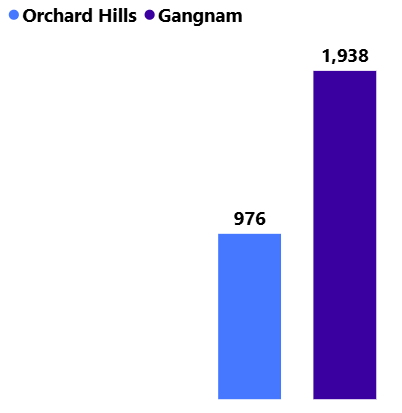
While the total price of a home is higher in Irvine, buyers in Seoul actually pay more for the same amount of living space.
Put simply, the same amount of money can generally buy you more space in Irvine than in Seoul.
So rather than asking only whether Irvine homes are “expensive,” it helps to ask another question:
How much living space are you actually getting for your money?
Irvine Offers More Choices and a More Balanced Market
Next, we looked at the distribution of home sale prices in 2026.
Transactions in Seoul tend to be concentrated within a narrower price range, while Irvine sales are spread across a broader range of prices.
That doesn’t necessarily mean Irvine offers more choices. Differences in property type, size, and location also matter.
But one thing is clear:
Homes across a wide range of price points are actively trading within the Irvine market.
It’s another reason why a single median price can’t tell the whole story.


Irvine: Where Data Can Reveal Entry Opportunities
Finally, we compared monthly home sales volume since 2023.
Seoul shows relatively large month-to-month swings. Irvine also has seasonal fluctuations, but sales tend to move within a more consistent range.
That alone doesn’t make the Irvine market predictable.
But when patterns repeat, data gives us an opportunity to better understand how the market moves.
Combine sales volume with prices, inventory, and Days on Market, and the questions become more useful.
Which area should I focus on?
What price makes sense?
When should I make a move?
The real question may not be simply:
“Should I buy now or wait?”
It may be:
Where, at what price, and when?


Expensive, but Worth a Look: Irvine
Yes. Irvine is an expensive housing market.
By total home price, it is significantly more expensive than Seoul.
But when you look at price per square foot, the same budget can buy you a larger home in Irvine than in Seoul. And within Irvine itself, market conditions vary widely by neighborhood and price segment.
No single number tells the whole story.
Price, space, location, inventory, sales activity, and timing all matter.
Better real estate decisions start with data, not intuition.


Comments